The short version
- 46 CFR parts 31 and 35 contain no first aid, medicine chest or medical provision of any kind.
- The only medical rule in Subchapter D is 46 CFR 32.40-35, a hospital space, filed under crew accommodation.
- It triggers on voyages over 3 days AND a crew of 12 or more, and names berths and plumbing but no medicine.
- Chemical and gas tonnage under Subchapter O must carry named antidotes. Petroleum tonnage gets a room.
- 46 U.S.C. 11102 still requires a medicine chest on a foreign voyage, from a statute Subchapter D never mentions.
The subchapter that governs the most dangerous cargo says almost nothing about people
Search 46 CFR Subchapter D for a first aid requirement and you will not find one. Search it for a medicine chest and you will not find one either.
We read the operating and inspection parts in full. Part 31, inspection and certification and part 35, operations contain no first aid provision, no medicine chest provision and no medical provision of any kind.[1][2]
One medical rule exists in the whole subchapter, and it is filed under crew accommodation rather than safety.
46 CFR 32.40-35, Hospital space, T/ALL
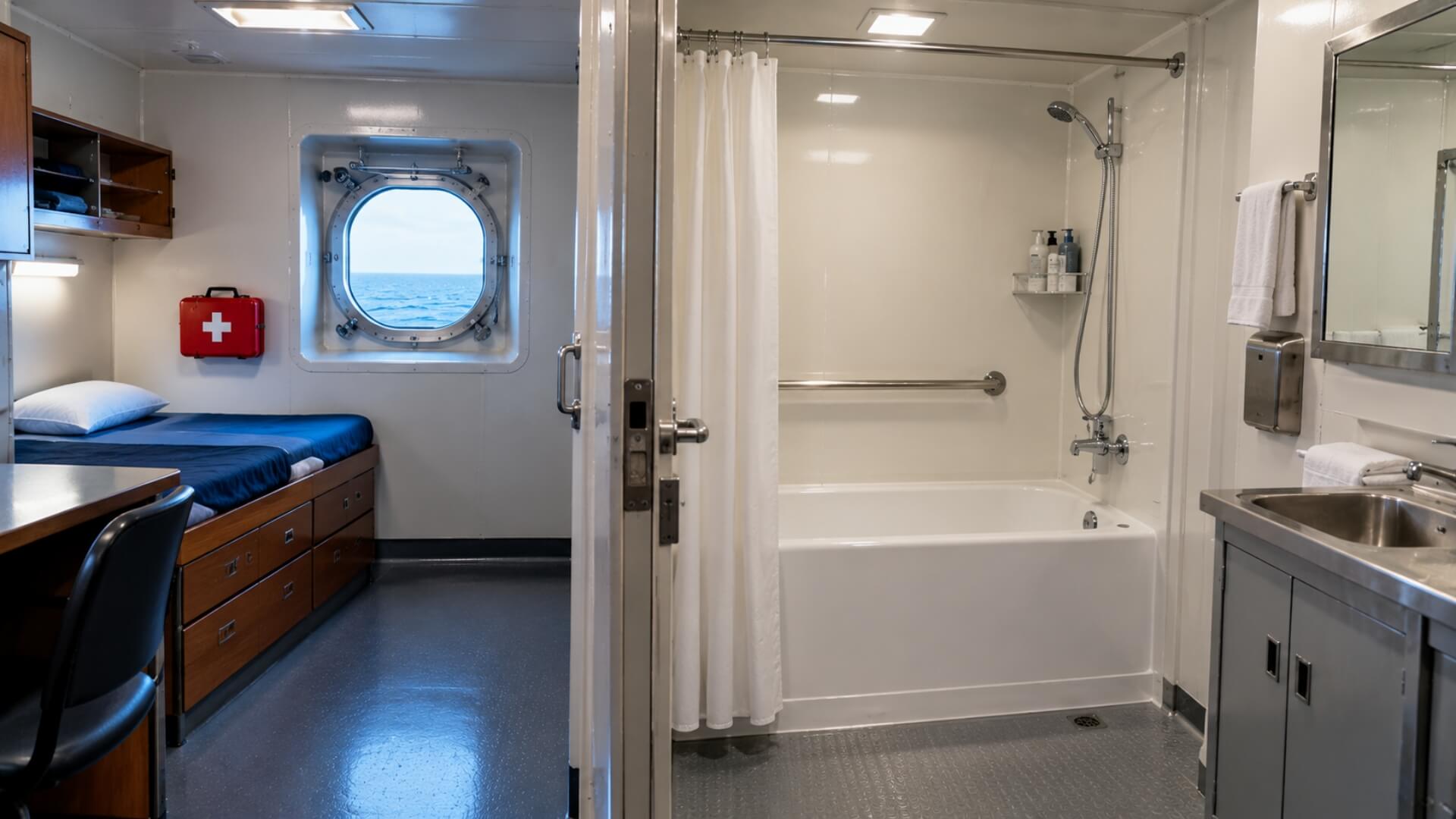
“Each vessel which in the ordinary course of its trade makes voyages of more than 3 days duration between ports and which carries a crew of 12 or more, must be provided with a hospital space. This space must be situated with due regard to the comfort of the sick so that they may receive proper attention in all weathers.”[3]
That is the entire medical footprint of the US tank vessel rulebook: a room, on a voyage threshold, above a crew count.
What the room must contain, and what it must not be used for
The section is short and unusually prescriptive about the space while saying nothing about what happens inside it.[3]
| Requirement | The rule | What it does not say |
|---|---|---|
| Trigger | Voyages of more than 3 days between ports and a crew of 12 or more[3] | Nothing about cargo. A crude tanker and a clean products tanker are treated identically |
| Separation | Suitably separated, used for the care of the sick and for no other purpose[3] | Storage between voyages breaches it |
| Berths | 1 berth per 12 crew not berthed in single occupancy rooms, capped at 6[3] | No equipment list of any kind |
| Fittings | Toilet, washbasin, bathtub or shower, plus a clothes locker, table and seat[3] | No oxygen, no stretcher, no medicines |
The trigger is conjunctive. Both limbs must be true, which is the same drafting shape as the casualty reporting threshold and the same one operators routinely read as an either/or. The wider hospital space rule sets out how the identical trigger appears across other US classes.
Two tankers, two rulebooks, and only one of them names a medicine
This is where US tank vessel regulation stops being intuitive. Which medical rules reach your ship depends on what is in the tanks, not on the fact that it is a tanker.
| Cargo | Governing subchapter | Named medical requirement? |
|---|---|---|
| Petroleum and other Subchapter D cargoes | 46 CFR Subchapter D, parts 30 to 40[1] | A hospital space only. No kit, no chest, no medicines[3] |
| Bulk liquid hazardous materials, Table 1 | 46 CFR part 153[4] | Yes. Antidotes from the IMO guide, as a condition of operating |
| Liquefied gas | 46 CFR part 154[5] | Yes. The guide, the antidotes and lifting equipment |
A crude oil tanker on a long voyage gets a room. A chemical tankship carrying a Table 1 cargo gets named antidotes as a condition of operating, and a liquefied gas carrier gets six separate medical sections.
Same fleet, same officers, three different answers. Operators running mixed tonnage write one procedure and unknowingly fail two of the three.
The nearest thing to a health rule in part 35 is about fire
Part 35 does contain a rule that protects people, and it is worth naming because it is often mistaken for a medical provision.
46 CFR 35.01-1 prohibits riveting, welding, burning or other fire producing work in or on the boundaries of cargo tanks, fuel tanks and their connected pipework until an inspection establishes it can be done safely, using NFPA 306 as a guide.[2] In a US port the inspection is made by a marine chemist certificated by the National Fire Protection Association, and a certificate must be issued before the work is started.[2]
Where no chemist is reasonably available, the inspection falls to the senior officer present and a proper entry must be made in the vessel’s logbook.[2] That is an atmosphere and fire control, not a casualty rule. It tells you nothing about treating the person the atmosphere harmed.
Federal law still requires a chest, it is just not in this subchapter
The absence in Subchapter D does not mean a tank vessel has no chest duty. It means the duty sits somewhere operators are not looking.
46 U.S.C. 11102 requires a medicine chest on a US vessel sailing from a US port to a foreign port other than Canada, with no tonnage floor on that limb, and on a vessel of at least 75 gross tons on an Atlantic to Pacific voyage.[6] Most US tank vessels on foreign trade are inside it.
The statute walkthrough covers the scope and the penalty, which runs against the owner and the master. What no federal source supplies is the contents list, which is why chest stocking has to be built from the WHO guide and the flag standard instead. Our ship medical chest management service writes that specification.
Everything else that reaches a tank vessel comes from outside Subchapter D
Read as a compliance map rather than a subchapter, the picture fills in quickly.
- Controlled substances. Anything scheduled in the chest brings 21 CFR 1301.25, recordkeeping and disposal with it. Our controlled substances service exists for this.
- Casualty response. An injury meeting the conjunctive test starts a two hour chemical testing clock.
- Ongoing testing. 46 CFR part 16 runs continuously against covered crewmembers.
- Survival craft. The lifeboat kit answers to ISO 18813 through 46 CFR 199.175, not to Subchapter D.
- Public health. A death or ill person on a voyage to a US port triggers the CDC report.
Not one of those five lives in the subchapter the tank vessel is certificated under. That is the practical problem: the rulebook on the bridge is not where the medical duties are.
Why this fleet is the one that can least afford the gap
Tank vessels combine long voyages, small crews, confined space entry and cargoes that injure by inhalation and contact. The exposure profile is high and the prescriptive medical rule is a room.
Planning by time to definitive care is the honest frame here, and the medevac decision is what the master will actually face. Fleets that change flag inherit a different chest standard, and the US statutory duty stays with the US registry.
Six checks for a Subchapter D operator
- Test the hospital space trigger honestly. More than 3 days between ports and 12 or more crew.[3]
- Confirm the room is used for nothing else. Stores in the hospital breaks the rule as written.[3]
- Check whether any hull in the fleet is Subchapter O. If so, it has a named medicine requirement the others do not.[4][5]
- Apply 46 U.S.C. 11102 to every foreign voyage, whatever Subchapter D omits.[6]
- Write your own chest contents standard and cite what it is built from.
- Do not mistake the marine chemist certificate for a medical control. It manages the atmosphere, not the casualty.[2]
Discovery Health MD is led by Ann Jarris MD, MBA, FACEP, a board certified emergency physician. Building a medical programme for a fleet whose own subchapter is silent, and auditing it the way an inspector checks, is exactly the work our maritime medical consulting line does. Programme frame in the six decisions. Speak to the team.
Common questions
Does 46 CFR Subchapter D require a first aid kit on a tank vessel?
No. Part 31, inspection and certification, and part 35, operations, contain no first aid provision, no medicine chest provision and no medical provision of any kind[1][2]. The only medical requirement in the whole subchapter is 46 CFR 32.40-35, a hospital space, and it sits in the crew accommodation subpart rather than in a safety part[3]. Medical duties for tank vessels come from outside Subchapter D.
When does a tank vessel need a hospital space?
On two conditions at once. 46 CFR 32.40-35(a) requires a hospital space on each vessel which in the ordinary course of its trade makes voyages of more than 3 days duration between ports and which carries a crew of 12 or more[3]. Both limbs must be true. A four-day voyage with 11 crew does not trigger it, and neither does a two-day voyage with 20.
What must the hospital space contain?
Berths and fittings, and no medical equipment at all. 46 CFR 32.40-35 requires the hospital to be suitably separated, used for the care of the sick and for no other purpose, fitted with berths in the ratio of one to every 12 crew not berthed in single occupancy rooms up to a maximum of six, and provided with a toilet, washbasin and bathtub or shower, plus a clothes locker, table and seat[3]. The section names no medicines, no oxygen and no stretcher.
Why do chemical tankers have medical rules when oil tankers do not?
Because the governing subchapter follows the cargo. A vessel carrying bulk liquid hazardous materials listed in Table 1 falls under 46 CFR part 153, which makes carriage of the IMO guide antidotes a condition of operating[4], and a liquefied gas carrier falls under 46 CFR part 154, which carries six separate medical sections[5]. A tank vessel carrying petroleum under Subchapter D gets a hospital space and nothing else[3]. Operators running mixed tonnage need class-specific annexes.
Is the marine chemist certificate a medical requirement?
No, and conflating them is common. 46 CFR 35.01-1 prohibits riveting, welding, burning or similar fire producing work in or on the boundaries of cargo and fuel tanks until an inspection establishes it can be done safely, using NFPA 306 as a guide, with a certificate issued by an NFPA certificated marine chemist before work starts in a US port[2]. Where no chemist is reasonably available the senior officer present inspects and makes a logbook entry. That is atmosphere and fire control, not casualty care.
Does a US tank vessel need a medicine chest at all?
Yes, by statute rather than by Subchapter D. 46 U.S.C. 11102 requires a medicine chest on a vessel of the United States sailing from a US port to a foreign port other than Canada, with no tonnage threshold on that limb, and on a vessel of at least 75 gross tons on a voyage between a US Atlantic port and a US Pacific port[6]. Most US tank vessels in foreign trade are inside it. No federal contents list exists, so the specification has to be written and cited.
Which medical rules actually reach a tank vessel?
Five, and none of them is in Subchapter D. Controlled substances under 21 CFR 1301.25 once anything in the chest is scheduled, serious marine incident chemical testing under 46 CFR subpart 4.06 with its two hour clock, the ongoing testing programme under 46 CFR part 16, the survival craft first aid kit under 46 CFR 199.175 and ISO 18813, and the CDC death and illness report under 42 CFR 71.21 on a voyage to a US port. The rulebook the vessel is certificated under is not where its medical duties live.