The short version
- 46 CFR 153.1(b) excludes barges endorsed for a limited short protected coastwise or inland route from part 153.
- Part 153 is where the antidote requirement lives, so the exclusion removes it while the cargo stays the same.
- 46 CFR part 151, which governs unmanned tank barges, contains no first aid, medicine chest, medical or antidote provision.
- Unmanned is a manning classification. Tankermen, tank entry crews and surveyors board routinely.
- 46 CFR 148.61 puts a first aid information duty on the shipper, with nothing required aboard to act on it.
The antidote requirement follows the route, not the cargo
Two barges load the same Table 1 chemical on the same day. One must carry named antidotes to operate. The other has no medical requirement at all. The difference is not the cargo and not the crew. It is the route on the certificate.
46 CFR 153.1(b), applicability to non-self-propelled ships
Part 153 applies to “all United States oceangoing non-self-propelled ships” carrying a Category A, B or C NLS cargo listed in Table 1, unless “the ship’s Certificate of Inspection is endorsed for a limited short protected coastwise route and the ship is constructed and certificated primarily for service on an inland route.”[1]
Read the exception. An inland tank barge is carved out of part 153 by its route endorsement. And part 153 is where the medical requirement lives: 46 CFR 153.930 makes carrying the IMO guide antidotes for the cargo a condition of operating.[2]
The antidote rule in full explains why that section is drafted as a prohibition rather than a duty. The point here is narrower and sharper: move the same chemical onto an inland barge and the antidotes stop being required.
Part 151 governs unmanned tank barges and contains no medical provision
The barge carved out of part 153 lands in 46 CFR part 151. We read it and searched it.
Zero matches for first aid. Zero for medicine chest. Zero for medical. Zero for antidote.[3] The part is about hulls, tanks, cargo authorisations and inspection intervals.
| Same cargo, different hull | Governing part | Medical requirement |
|---|---|---|
| Self-propelled tankship | 46 CFR part 153[1] | Named antidotes, as a condition of operating[2] |
| Oceangoing tank barge | 46 CFR part 153[1] | Named antidotes, same rule |
| Inland or short protected coastwise tank barge | 46 CFR part 151[1][3] | None. The part contains no medical provision |
That silence is not unique. Subchapter L offshore supply vessels and uninspected vessels sit in the same position, and MODUs get a facility rather than equipment. The only inspection duty part 151 sets for these hulls is structural and periodic: every unmanned tank barge subject to the subchapter must be inspected every five years, more often if the Officer in Charge, Marine Inspection requires it.[4] Five years is a long interval to carry a hazardous cargo with no medical rule attached.
Unmanned does not mean nobody is aboard
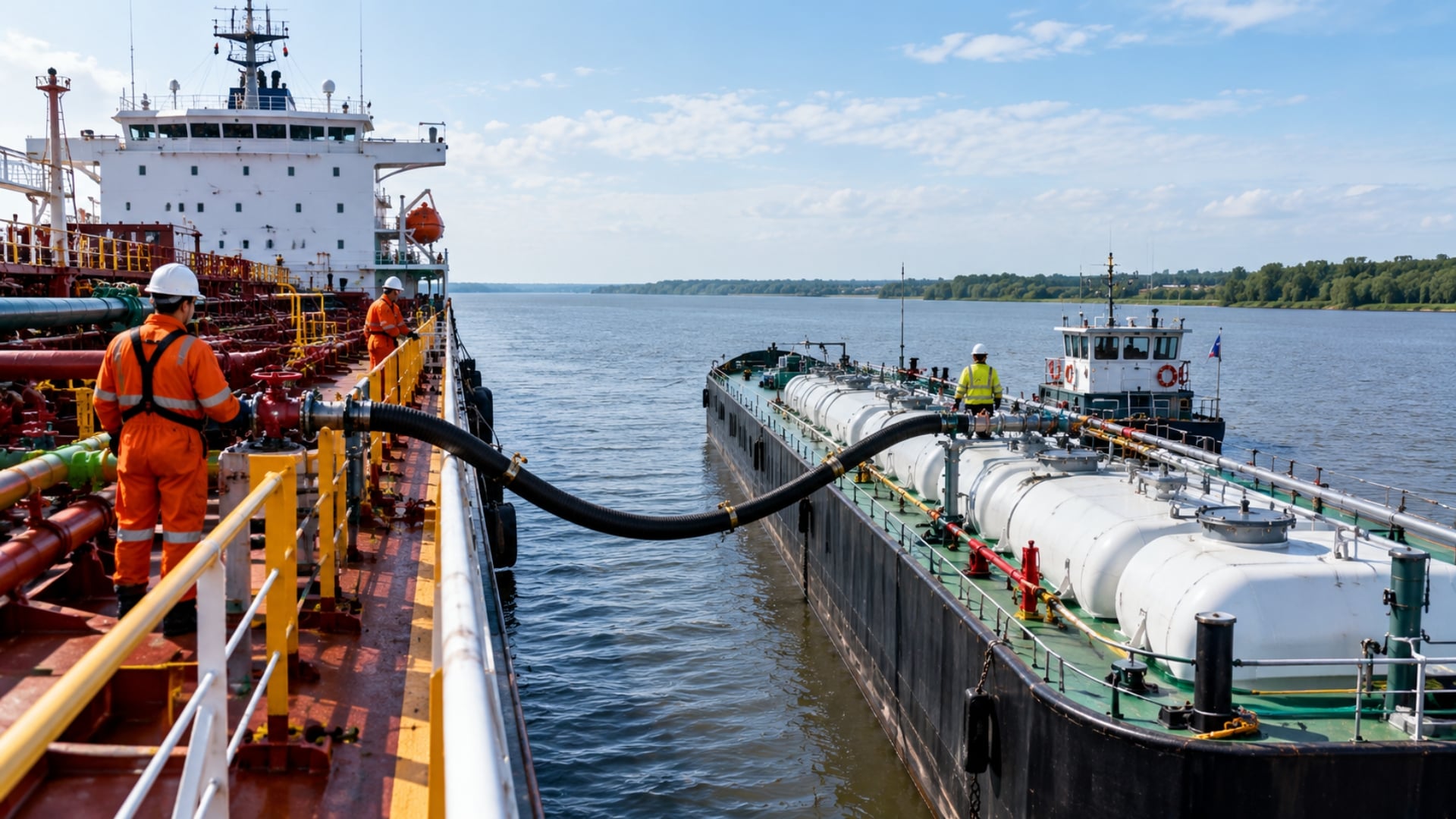
This is where the regulatory logic and the operational reality separate. A barge is unmanned as a manning classification. People still board it, routinely and in the worst conditions.
- Tankermen during loading and discharge, at the point of maximum exposure.
- Tank entry and cleaning crews, working in a confined space that recently held the cargo.
- Towing vessel crew crossing to make up or break tow, in weather.
- Surveyors and inspectors, on the five-yearly cycle and on damage.
- Shoreside gangs at the dock, where the kit comparison by class shows how thin the nearest provision usually is.
None of those people is covered by a medical requirement attached to the barge, because there is none. Whatever they get comes from the towing vessel under Subchapter M or from the shore facility.
The question to ask your port captain
When a tankerman is injured on the barge, whose kit treats him, and how far is it? If the answer is the towing vessel, then the towing vessel’s medical provision is doing double duty for a hull it does not cover, and nobody has written that down.
For dry bulk hazardous cargo the duty lands on the shipper, not the vessel
46 CFR part 148 governs bulk solid hazardous materials, and it does contain the words first aid. It puts them somewhere unexpected.
46 CFR 148.61, Emergency response information
“The shipper of a material listed in Table 148.10 of this part must provide the master or his representative with appropriate emergency response information … The information must include preliminary first aid measures and emergency procedures to be carried out in the event of an incident or fire involving the cargo.”[5]
Compare 46 CFR 154.1435, which requires the guide itself to be aboard a gas carrier. That is an information duty on the shipper, discharged by shipping papers or a material safety data sheet, and it must be kept aboard with the dangerous cargo manifest.[5] It tells the master what to do. It does not require the vessel to carry a single item with which to do it.
What actually reaches a barge operation
Read as a fleet rather than a hull, the duties reappear from other parts of the code.
| Duty | Where it comes from | Does it reach the barge? |
|---|---|---|
| Chemical testing after a serious marine incident | 46 CFR subpart 4.06, via the marine casualty definition[6] | Yes. Written around any vessel other than a public vessel on US navigable waters |
| Ongoing random and reasonable cause testing | 46 CFR part 16[7] | Yes, for covered crewmembers on the towing vessel |
| Medicine chest | 46 U.S.C. 11102[8] | Only on a qualifying foreign or intercoastal voyage |
| Survival craft first aid kit | 46 CFR 199.175[9] | Follows the inspected vessel, not the barge |
| Controlled substances | 21 CFR 1301.25[10] | Follows the chest, wherever it is held |
The two hour testing clock is the one most likely to catch a barge operation unprepared, because the injury happens on a hull with no medical equipment and the clock starts anyway. The conjunctive injury test decides whether it runs at all.
What a competent barge operator writes down
Because the regulation supplies nothing, the standard has to be authored. That is not a gap to complain about, it is the deliverable.
- A named medical provision for barge work, sized to the people who actually board, not to the barge’s manning classification.
- A cargo-to-antidote map for every Table 1 cargo the fleet handles, even where part 151 exempts the hull. The clinical need does not follow the route endorsement.[2]
- A confined space medical annex, because tank entry is where this fleet gets hurt, and the diving rules are the nearest US analogue for a confined-space casualty.
- An escalation written against distance, which is what planning by time to definitive care does, and what the medevac decision turns on.
Where the chest holds anything scheduled, 21 CFR 1301.25 and its recordkeeping attach to whoever holds it. Our controlled substances service handles that layer, and our ship medical chest management service sizes and dates the inventory across the fleet rather than per hull.
Six checks for a tank barge fleet
- Read the route endorsement on each Certificate of Inspection. That single line decides whether part 153 or part 151 governs.[1]
- List which hulls carry Table 1 cargo but sit outside part 153. Those are the exposure.[1]
- Name whose kit treats a tankerman injured on the barge, in writing.
- Collect the 148.61 emergency response information for every dry bulk hazardous cargo and check it is aboard with the manifest.[5]
- Brief the towing vessel master on the conjunctive injury test, because the testing clock does not care which hull it happened on.[6]
- Do not treat the five year inspection interval as a medical review. It is structural.[4]
Discovery Health MD is led by Ann Jarris MD, MBA, FACEP, a board certified emergency physician. Writing a medical standard for a fleet whose governing part contains none, and auditing it the way an inspector checks, is exactly what our maritime medical consulting line does. Programme frame in the six decisions, and the wider tank vessel picture sets out how thin Subchapter D already is. Speak to the team.
Common questions
Does an unmanned tank barge need a first aid kit?
Not under the part that governs it. 46 CFR part 151, which covers unmanned tank barges, contains no first aid provision, no medicine chest provision, no medical provision and no antidote provision[3]. Its inspection duty is structural: every unmanned tank barge subject to the subchapter must be inspected every five years, more often if the Officer in Charge, Marine Inspection requires it[4]. Whatever medical provision reaches the people who board comes from the towing vessel or the shore facility.
Why do some tank barges need antidotes and others do not?
The route endorsement decides it. 46 CFR 153.1(b) applies part 153 to United States oceangoing non-self-propelled ships carrying Category A, B or C NLS cargo, but excludes a ship whose Certificate of Inspection is endorsed for a limited short protected coastwise route and which is constructed and certificated primarily for service on an inland route[1]. Part 153 is where 46 CFR 153.930 makes carriage of the IMO guide antidotes a condition of operating[2], so the exclusion removes the antidote requirement while the cargo stays the same.
Who is actually on board an unmanned barge?
More people than the classification implies. Tankermen during loading and discharge, tank entry and cleaning crews working in a space that recently held the cargo, towing vessel crew crossing to make up or break tow, and surveyors on the inspection cycle. Unmanned is a manning classification, not a description of who stands on the deck. None of those people is covered by a medical requirement attached to the barge, because the governing part sets none.
What does 46 CFR 148.61 require?
Information from the shipper, not equipment on the vessel. 46 CFR 148.61 requires the shipper of a material listed in Table 148.10 to provide the master or his representative with appropriate emergency response information, which may be on the shipping papers or in a separate document such as a material safety data sheet, and which must include preliminary first aid measures and emergency procedures for an incident or fire involving the cargo[5]. It must be kept aboard with the dangerous cargo manifest. It tells the master what to do without requiring anything to do it with.
Does the serious marine incident testing rule apply to a barge?
Yes. 46 CFR 4.03-1 defines a marine casualty around any vessel other than a public vessel involved in a casualty occurring on the navigable waters of the United States, so the hull’s manning classification is irrelevant[6]. If an injury requires professional medical treatment beyond first aid and renders the person unfit for routine duties, alcohol testing has a two hour deadline and drug specimen collection has 32 hours. The injury happens on a hull with no medical equipment and the clock starts anyway.
Does a barge operator need a medicine chest?
Only where 46 U.S.C. 11102 reaches the operation. The statute requires a medicine chest on a vessel of the United States sailing from a US port to a foreign port other than Canada, with no tonnage floor on that limb, and on a vessel of at least 75 gross tons on a voyage between a US Atlantic port and a US Pacific port[8]. A domestic inland barge operation is usually outside it. That is a reason to write a standard rather than a reason to carry nothing.
What should a tank barge fleet write down?
Four things the regulation does not supply. A named medical provision sized to the people who board rather than to the barge’s manning classification. A cargo-to-antidote map for every Table 1 cargo handled, including hulls the route endorsement exempts, because the clinical need does not follow a certificate. A confined space medical annex, since tank entry is where this fleet gets hurt. And an escalation written against distance to definitive care.