The short version
- 46 CFR 169.725 requires an approved first aid kit to subpart 160.041. That is the whole medical content of part 169.
- The full section list was read. No medicine chest, no hospital space, no medical training, no illness procedure.
- 169.107 defines sailing school students and instructors, and attaches no medical obligation to either.
- An instructor is expressly not a required crew member, so they are not the assigned medical responder.
- Four federal medical rules reach these vessels from outside Subchapter R, and part 169 signposts none of them.
One sentence, in a subchapter of several hundred
United States sailing school vessels are governed by 46 CFR part 169, Subchapter R. The complete medical content of that part is a single sentence.
46 CFR 169.725, First aid kit, in full
“Each vessel must carry an approved first aid kit, constructed and fitted in accordance with subpart 160.041 of this chapter.”[1]
That is the entire section. It is also the only medical provision in the part. The full section list was read to confirm it, every subpart from 169.100 General Provisions through 169.800 Operations.[2]
No medicine chest. No hospital space. No medical training requirement. No illness procedure. No provision for the fact that the people aboard are students.
The regulation defines the students and then forgets them
Part 169 is unusually precise about who is aboard. Section 169.107 defines a sailing school student as a person who is aboard a sailing school vessel for the purpose of receiving sailing instruction.[3]
It defines a sailing school instructor more narrowly still: any person aboard for sailing instruction provision who is not an officer, operator, or crew member required by regulation, and who has not paid consideration for carriage.[3]
Two defined populations, neither of them crew, neither of them passengers. And nothing in the part attaches a single medical obligation to either.
The counting problem is familiar. Research vesselshit it with scientific personnel, and the hospital space rulesturn on whether a regulation counts crew or persons.
| Population | Defined at | Medical provision attached |
|---|---|---|
| Sailing school student | 169.107[3] | None |
| Sailing school instructor | 169.107, and expressly not a required crew member[3] | None |
| Officers and required crew | Credentialing rules outside part 169 | The approved first aid kit at 169.725 serves the whole vessel[1] |
The instructor definition matters commercially. An instructor is expressly not a required crew member, so a programme that assumes the instructor is the medical responder has assumed a role the regulation never assigns. The owner and DPA questionis the right frame for deciding who does hold it.
A minor population and the thinnest rule set in Title 46
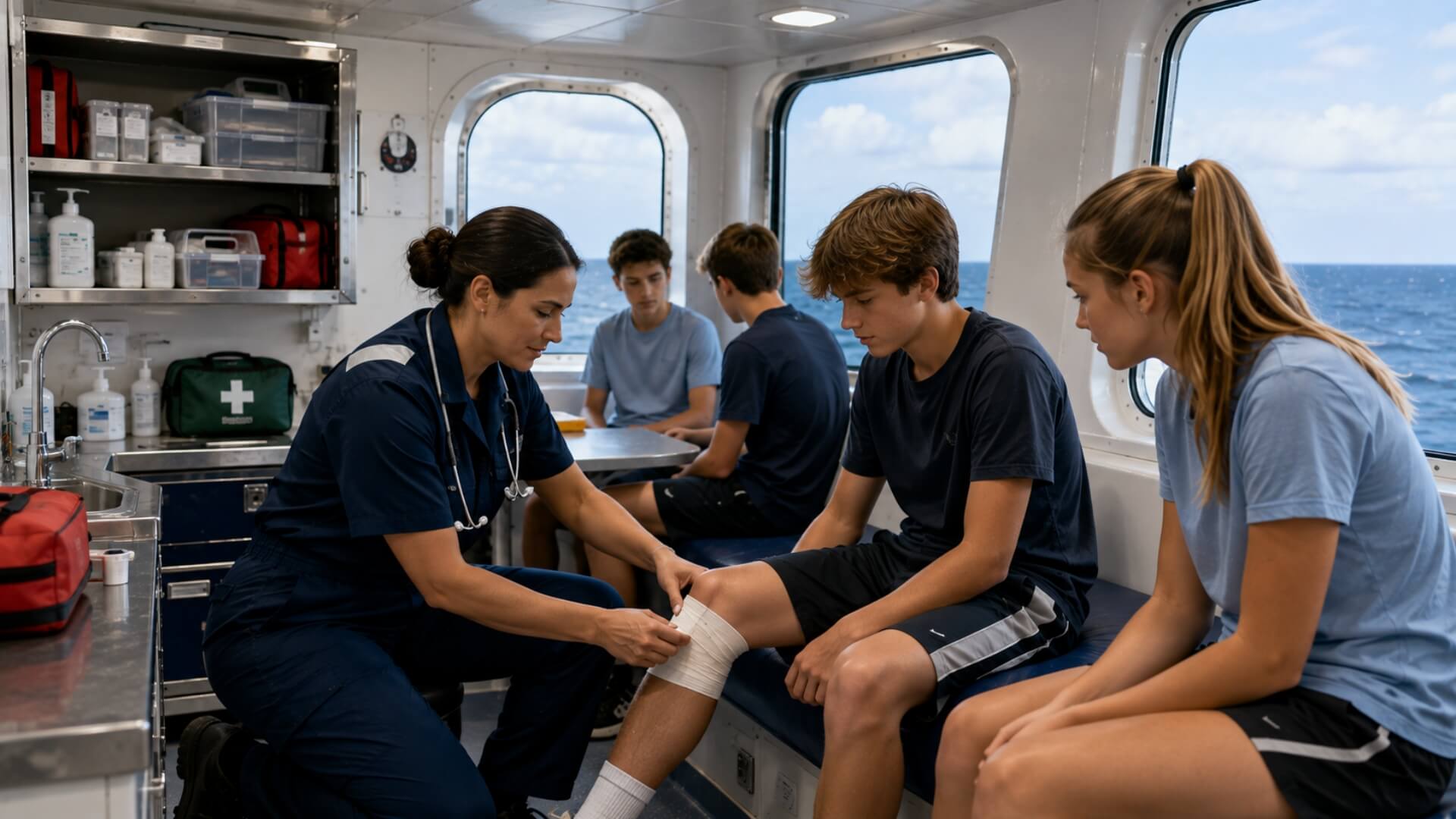
This is the uncomfortable part. Sailing school vessels carry teenagers on multi day voyages, frequently offshore, and they carry the lightest medical requirement of any inspected class.
| Class | Medical rule | Depth |
|---|---|---|
| Sailing school Subchapter R |
169.725, approved first aid kit[1] | One sentence. Nothing else in the part |
| Small passenger Subchapter T |
184.710, first aid kits[4] | A section with structure, and an ISO route at the end of the chain |
| Commercial fishing Part 28 |
28.210, first aid equipment and training[5] | Kit plus certified first aiders tiered by headcount, plus monthly drills |
A commercial fishing vessel crewed by adult professionals carries a training obligation. A sailing school vessel carrying sixteen year olds does not.[1][5] Read the Subchapter T comparison and the part 28 chest rules for what the neighbours carry. Uninspected vesselsand the wider part 28 picturecomplete the class map.
No regulator is going to close this. The gap is closed by the operator, in policy, or it stays open. That is a consulting conversation rather than a compliance one.
Approved means a type approval, not a contents list
The word carrying all the weight in 169.725 is approved. It points at subpart 160.041, which is a Coast Guard equipment type approval standard.[6]
A type approval tells a manufacturer what to build and a vessel what to buy. It does not tell a master what to do at two in the morning with a student who has a head injury four hours from a harbour.
The distinction runs through this whole site. Kit requirements by vessel class sets out where each class lands, and how to stock a ship medicine chest is the method for the layer above the approved kit. Where a vessel sails far enough offshore, planning by time to definitive carereplaces the kit question entirely, and the medevac decisionis the one that actually gets made at sea.
Buying the approved kit is the floor, not the programme
An approved kit satisfies 169.725 on the day of inspection.[1] It does not address prescription medication, an anaphylaxis plan, a student who arrives with an inhaler, or who may lawfully hold and give anything. Those are policy documents, and part 169 will not prompt you to write them.
Five operations sections a medical programme can attach to
Because part 169 creates no medical procedure, a programme has to hang itself on the operational duties that do exist. Subpart 169.800 provides five clean anchors.[2]
| Section | Duty | Medical use |
|---|---|---|
| 169.817 | Master to instruct ship’s company[7] | The authority to make medical briefing mandatory, without inventing one |
| 169.855 | Pre-underway training[8] | Where student medical disclosure and allergy screening belongs |
| 169.813 | Station bills[9] | Assign the medical responder by position, since the instructor is not required crew |
| 169.833 | Fire and boat drills[10] | The only recurring drill cycle. Add a medical scenario to it |
| 169.841 | Logbook entries[11] | The record that proves the briefing, the screening and the decision happened |
Notice of casualty sits separately at 169.807.[12] When an injury crosses the reporting threshold the duty is the same as any other inspected vessel, which is worked through in what counts as treatment beyond first aid, the crew record duties in crew medical records, and the worst case in death on board.
What reaches the vessel from outside Title 46
An operator reading only part 169 will conclude the medical obligations are almost nothing. Three federal rules outside Subchapter R say otherwise, and none of them is signposted from part 169.
- Quarantine reporting. 42 CFR 71.21 requires an immediate report of any death or ill person to the quarantine station before a US port call, with a fifteen day lookback. See the CDC reporting article.
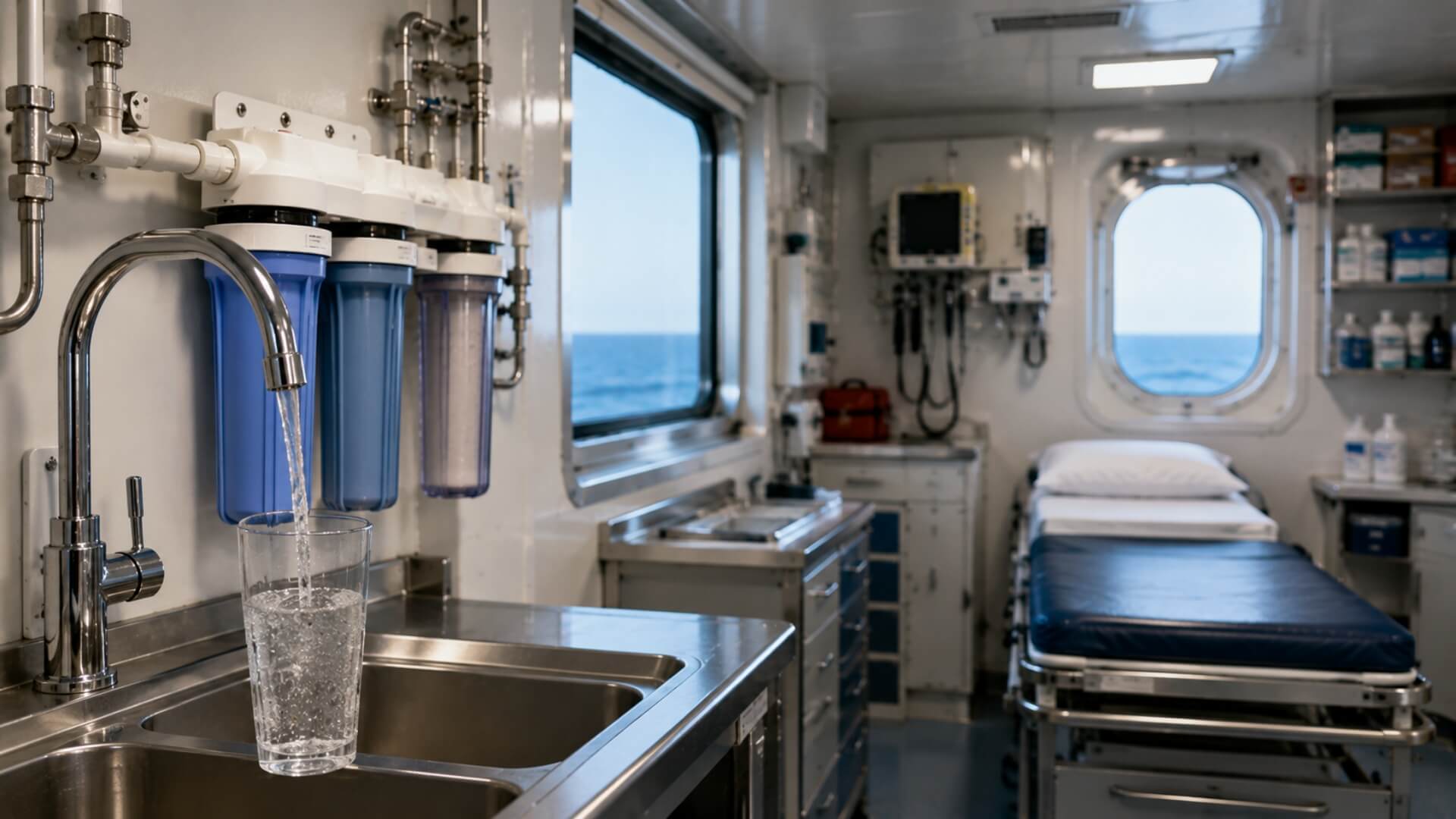
- Sanitation and potable water. The FDA regulates vessels in interstate traffic under 21 CFR part 1250, including water in medical care spaces. See the vessel sanitation article.
- Controlled substances. If anything scheduled is aboard, 21 CFR 1301.25 applies regardless of vessel class. See the walkthrough and the two route comparison.
- Medical waste. A sharps container is plastic and may never go over the side. See the waste chain.
That is four federal obligations a sailing school operator can meet without ever opening part 169, and four that part 169 will never mention. A compliance audit that only reads the vessel’s own subchapter will find none of them.
The programme part 169 does not write for you
- Buy and log the approved kit to subpart 160.041. That is 169.725 satisfied.[1][6]
- Write a student medical disclosure form and run it at 169.855 pre-underway training.[8]
- Name the medical responder on the station bill at 169.813, by position, not by assuming the instructor.[9][3]
- Add a medical scenario to the 169.833 drill cycle.[10]
- Write the medication policy: what a student may hold, what the vessel holds, who may give it.
- Settle the minors question in writing: consent, guardian contact and the threshold for calling ashore.
- Put the four outside rules on the compliance register, because part 169 will not.
Discovery Health MD is led by Ann Jarris MD, MBA, FACEP, a board certified emergency physician. Programmes for vessels carrying students are built the way the six decisions describe, sized by time to definitive care, and stocked through ship medical chest management. Speak to the team.
Common questions
What are the medical requirements for a US sailing school vessel?
One sentence. 46 CFR 169.725 states that each vessel must carry an approved first aid kit, constructed and fitted in accordance with subpart 160.041 of this chapter[1]. That is the only medical provision in the whole of part 169, confirmed by reading the full section list from 169.100 General Provisions through 169.800 Operations[2]. There is no medicine chest rule, no hospital space, no medical training requirement and no illness procedure. Our consulting service builds what the regulation leaves out.
Does part 169 require medical training for instructors?
No. Part 169 contains no medical training requirement of any kind[2]. It also defines a sailing school instructor at 169.107 as a person aboard for sailing instruction provision who is not an officer, operator, or crew member required by regulation, and who has not paid consideration for carriage[3]. So a programme that assumes the instructor is the medical responder has assigned a role the regulation never gave them. Name the responder on the station bill at 169.813 instead.
Do sailing school students get any medical protection in the rules?
None specific to them. 46 CFR 169.107 defines a sailing school student as a person aboard for the purpose of receiving sailing instruction, and no medical obligation anywhere in part 169 attaches to that status[3]. The approved first aid kit at 169.725 serves the vessel generally[1]. This matters because the population is frequently made up of minors on multi-day offshore voyages, carrying the lightest medical rule set of any inspected class.
What does approved mean in 46 CFR 169.725?
It points at a Coast Guard equipment type approval standard, subpart 160.041[6]. A type approval tells a manufacturer what to build and a vessel what to buy. It does not set a clinical standard, address prescription medication, or say who may lawfully hold and give anything aboard. Buying the approved kit satisfies 169.725 on inspection day and is the floor rather than the programme. Read how to stock a ship medicine chest for the layer above it.
How does the sailing school rule compare to other vessel classes?
It is the thinnest. Sailing school vessels get one sentence at 169.725[1]. Small passenger vessels under Subchapter T get 46 CFR 184.710 with real structure[4]. Commercial fishing vessels under 46 CFR 28.210 get first aid equipment AND training, with certified first aiders tiered by headcount and monthly drills[5]. A fishing vessel crewed by adult professionals carries a training obligation that a vessel carrying sixteen year olds does not.
Which operations sections can a medical programme attach to?
Five in subpart 169.800[2]. 169.817 master to instruct ship’s company[7] gives the authority to make a medical briefing mandatory. 169.855 pre-underway training[8] is where student medical disclosure belongs. 169.813 station bills[9] is where the responder gets named by position. 169.833 fire and boat drills[10] is the only recurring drill cycle, so add a medical scenario. 169.841 logbook entries[11] is the proof.
What federal medical rules apply that are not in part 169?
At least four. 42 CFR 71.21 requires an immediate quarantine report of any death or ill person before a US port call. 21 CFR part 1250 subpart E is the FDA sanitation rule covering potable water including medical care spaces. 21 CFR 1301.25 governs any controlled substance aboard regardless of vessel class. And 33 CFR 151.67 prohibits discharging plastic, which covers sharps containers. None is signposted from part 169, so a compliance audit reading only Subchapter R will miss all four.