The short version
- 46 CFR 16.500(b)(1) requires the MIS data by 15 March of the year following collection.
- Alcohol testing data is not required and not permitted to be submitted under that section.
- A consortium may file for you, but 16.500(b)(4) makes the marine employer responsible for the accuracy.
- 46 CFR 16.401 requires an Employee Assistance Program, with at least 60 minutes of supervisor training.
- 46 CFR 16.115: not more than $5,000 per violation, and each day of a continuing violation is separate.
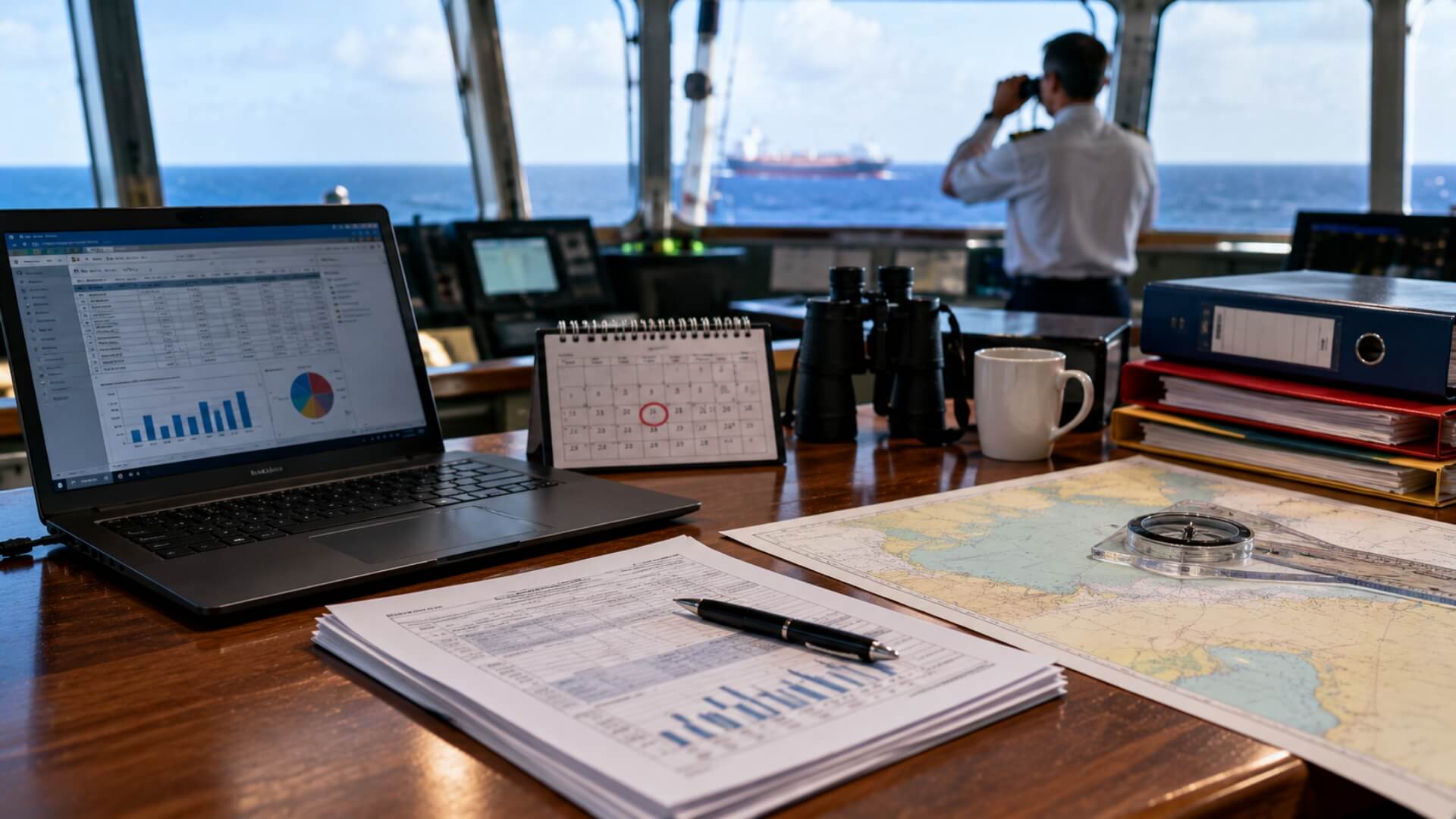
There is a hard date in this rule, and it is 15 March
Most of 46 CFR part 16 runs continuously. One duty has a calendar deadline, and missing it is the easiest violation on the whole site to prove.
46 CFR 16.500(b)(1)
“By March 15 of the year following the collection of the data in paragraph (a) of this section, marine employers must submit the data on the form titled U.S. Department of Transportation Drug and Alcohol Testing MIS Data Collection Form (OMB Number: 2105-0529)” to Commandant (CG-INV), Office of Investigations and Casualty Analysis, by mail or over the internet.[1]
The data itself is the drug testing programme data required by 49 CFR 40.26 and appendix H to 49 CFR part 40.[1][2] The report covers the previous calendar year, so the 2026 form is due by 15 March 2027.
The counterintuitive part
Alcohol testing data is not required, and is not permitted. 46 CFR 16.500(a)(2) states that the 49 CFR part 40 provisions for alcohol testing do not apply to the Coast Guard or to marine employers, and alcohol data is neither required nor permitted to be submitted under the section.[1] Employers who file a combined DOT-style return are submitting something the rule excludes.
Your consortium can file it. You still own it
This is the provision that catches members of a third party programme, and the drafting is unusually direct.
| Provision | What it permits | What it still requires of you |
|---|---|---|
| 16.500(b)(3) | A consortium or other employer representative may submit data for a marine employer, and one report may cover several employers[1] | Each report must list the marine employers included |
| 16.500(b)(4) | Nothing. It is a duty, not a permission | Marine employers must ensure the data submitted by the consortium is correct[1] |
Read (b)(4) as an owner. Outsourcing the filing does not outsource the accuracy. The only way to satisfy it is to hold your own numbers, which is the same discipline the records duty at 46 CFR 16.260 demands and the same one an inspection checklist tests.
The small operator exemption, and the three years you have to serve first
Part 16 does relieve very small employers, but only after they have proved a filing history.
46 CFR 16.500(c)
After filing 3 consecutive annual MIS reports since 1 January 1996, marine employers with 10 or fewer covered employees may stop filing the annual report each succeeding year during which they have no more than 10 covered employees.[1]
Three conditions, all of which fail quietly. The three reports must have been filed, the count is of covered employees rather than headcount, and the relief lapses in any year the count goes above ten. A seasonal operator crossing the threshold for one summer owes a report for that year.
Who is covered is decided by function, and the covered crewmember test sets it out. On a small passenger vessel the passenger control role pulls people in that an owner would not count as crew.
Four groups the definition deliberately leaves out
46 CFR 16.105 defines crewmember and then carves out four categories on vessels owned in the United States.[3]
- Fish processing personnel primarily employed preparing fish or fish products, or in a support position, with no duties directly affecting safe operation.[3]
- Scientific personnel on an oceanographic research vessel.[3] The same population the hospital space rule also declines to count.
- Industrial personnel on industrial vessels, as defined in the chapter.[3]
- Individuals not required under 46 CFR part 15 who have no duties directly affecting safe operation.[3]
The fishing carve-out is the one worth reading twice, because it splits a single crew. A processor is out, a deckhand holding a credential is in. The fishing vessel medical rules and the Alaska picture show how often that fleet is treated as one population when the regulations treat it as two.
The duty nobody runs: an Employee Assistance Program
46 CFR 16.401 is one paragraph and it creates a standing obligation most operators have never actioned.[4]
46 CFR 16.401
“The employer shall provide an Employee Assistance Program (EAP) for all crewmembers.” It may be internal or contracted out, and it must include both an education programme and a training programme.[4]
| Component | Minimum content | Evidence required |
|---|---|---|
| Education | Display and distribution of informational material, a community service hot-line number, and the employer’s drug and alcohol policy[4] | Displayed, not filed |
| Training | Effects and consequences of use on health, safety and the work environment, plus the manifestations and behavioural cues of use and abuse[4] | Documentation of training given |
| Supervisors | Supervisory personnel must receive at least 60 minutes of training[4] | The only numeric training duty in part 16 |
The behavioural cues element is not decoration. It is what makes reasonable cause testing defensible, because that test turns on a reasonable and articulable belief formed from direct observation. Without the training, the observation has no foundation.
What is actually tested, and what it costs to get this wrong
46 CFR 16.113 requires testing under 49 CFR part 40 using only laboratories certified by the Department of Health and Human Services, and each specimen is tested for five substances: marijuana, cocaine, opiates, phencyclidine and amphetamines.[5]
The penalty provision is separate from the one that governs incidents. 46 CFR 16.115 makes violation of part 16 subject to the civil penalties in 46 U.S.C. 2115, and provides that any person who fails to implement or conduct chemical testing as prescribed is liable for a civil penalty of not more than $5,000 for each violation, with each day of a continuing violation constituting a separate violation.[6][7]
Read the last clause carefully. A programme that is not running is not one violation. It is one per day.
Where this stops being paperwork
Two of these duties are clinical, not administrative. The behavioural cue training that supports reasonable cause is a medical education task, and every positive result is reviewed by a physician acting as Medical Review Officer before it becomes a finding.
A crewmember on legitimate prescription medication is the ordinary case. That is a question about the person, and it sits beside the crew medical record and beside what is in the chest, because anything scheduled aboard brings 21 CFR 1301.25 with it. Our maritime medical consulting line covers the clinical half, and our controlled substances service the regulated half.
Where an incident is involved, the serious marine incident rules take over with their own two hour and 32 hour clocks. Part 16 is the programme that has to exist before that day arrives.
Seven checks before 15 March
- Diary 15 March as a hard compliance date, for the previous calendar year’s data.[1]
- Ask your consortium for the filed return and check your own vessels are listed on it.[1]
- Verify the numbers yourself. 16.500(b)(4) makes accuracy your duty, not theirs.[1]
- Strip alcohol data out of anything filed under this section.[1]
- Test the small operator relief properly. Three filed reports, ten or fewer covered employees, every year.[1]
- Stand up the EAP, with material displayed and 60 minutes of supervisor training documented.[4]
- Count the daily exposure. $5,000 per violation, each day a separate violation.[6]
Discovery Health MD is led by Ann Jarris MD, MBA, FACEP, a board certified emergency physician. Part 16 belongs inside the medical programme rather than in a separate compliance folder, and an audit should ask for the MIS return and the EAP training record in the same visit. The owner and DPA split decides who owns the date. Speak to the team.
Common questions
When is the USCG MIS report due?
By 15 March, for the previous calendar year. 46 CFR 16.500(b)(1) requires marine employers to submit the data by March 15 of the year following collection, on the U.S. Department of Transportation Drug and Alcohol Testing MIS Data Collection Form, OMB Number 2105-0529, to Commandant (CG-INV), Office of Investigations and Casualty Analysis, by mail or over the internet[1]. The underlying data is what 49 CFR 40.26 and appendix H to 49 CFR part 40 require[2].
Does the MIS report include alcohol testing data?
No, and submitting it is outside the rule. 46 CFR 16.500(a)(2) states that the provisions in 49 CFR part 40 for alcohol testing do not apply to the Coast Guard or to marine employers, and that alcohol testing data is not required or permitted to be submitted by the section[1]. Employers who file a combined DOT-style return that includes alcohol data are reporting something this section excludes.
Can a consortium file the MIS report for us?
Yes, and you remain responsible for it. 46 CFR 16.500(b)(3) allows a consortium or other employer representative to submit data for a marine employer, and permits one report to cover several employers provided each report lists the marine employers included[1]. Paragraph (b)(4) then requires marine employers to ensure that the data submitted on their behalf is correct. Outsourcing the filing does not outsource the accuracy, so hold your own numbers.
Can a small operator stop filing the annual report?
Only after three years, and only while the count holds. 46 CFR 16.500(c) provides that after filing 3 consecutive annual MIS reports since 1 January 1996, marine employers with 10 or fewer covered employees may stop filing each succeeding year during which they have no more than 10 covered employees[1]. The count is of covered employees rather than total headcount, and the relief lapses in any year the number goes above ten, so a seasonal operator crossing the threshold owes a report for that year.
Who is excluded from the definition of crewmember?
Four groups, on vessels owned in the United States. 46 CFR 16.105 carves out fish processing personnel primarily employed preparing fish or fish products or in a support position with no duties directly affecting safe operation, scientific personnel on an oceanographic research vessel, industrial personnel on industrial vessels as defined in the chapter, and individuals not required under 46 CFR part 15 who have no duties directly affecting safe operation[3]. The fishing carve-out splits a single crew: a processor is out, a credentialed deckhand is in.
Is an Employee Assistance Program mandatory for marine employers?
Yes. 46 CFR 16.401 states that the employer shall provide an Employee Assistance Program for all crewmembers, either internally or by contract, and it must include an education programme and a training programme[4]. Education means displaying and distributing informational material, a community service hot-line number and the employer’s drug and alcohol policy. Training must cover the effects and consequences of use and the behavioural cues of use and abuse, must be documented, and supervisory personnel must receive at least 60 minutes.
What is the penalty for failing to run a part 16 programme?
Five thousand dollars, and it repeats daily. 46 CFR 16.115 makes violation of part 16 subject to the civil penalties in 46 U.S.C. 2115 and provides that any person who fails to implement or conduct, or otherwise fails to comply with, the requirements for chemical testing for dangerous drugs is liable for a civil penalty of not more than $5,000 for each violation, with each day of a continuing violation constituting a separate violation[6][7]. A programme that is not running is not one violation.