The US monkeypox outbreak is continuing to grow with over 14,000 confirmed cases as of last week. King County, Washington declared monkeypox a public health emergency and Discovery Health MD is assisting with monkeypox vaccinations for high-risk individuals.
Monkeypox is a viral infection that spreads through close contact including contact with respiratory secretions and through bedding and towels. It is only a matter of time before it finds its way onto a vessel. The high-density and congregate living nature of vessels means that spread would be likely. All vessel medical personnel should be aware of the signs and symptoms of monkeypox and what to do if a case is suspected.
What is monkeypox?
Monkeypox is a virus from the same family as the variola virus, the virus that causes smallpox. Fortunately, death from monkeypox infection is rare, but the rash can be extremely painful. Monkeypox is not related to chickenpox.
How is it transmitted?
Monkeypox can spread to anyone through close, personal, often skin-to-skin contact. Usually transmission occurs if there is direct contact with monkeypox rash, scabs, or body fluids from a person with monkeypox. However, infectious secretions can survive in fabrics and can infect someone if bedding or towels are shaken or handled by someone without PPE.
Viruses from this family are very sensitive to UV light and common disinfectants. The disinfectants used to prevent COVID spread are appropriate to use to prevent monkeypox spread.
What are the signs and symptoms of monkeypox infection?
Monkeypox symptoms usually start within 3 weeks of exposure to the virus. If someone has flu-like symptoms from infection, they will usually develop a rash 1-4 days later.
People are thought to be infectious from the time symptoms start until the rash has healed, all scabs have fallen off, and a fresh layer of skin has formed. The illness typically lasts 2-4 weeks. It is not known at this time if asymptomatic people can spread monkeypox.
In addition to a rash, people may have fever, chills, swollen lymph nodes, fatigue, muscle aches, headache, and respiratory symptoms.
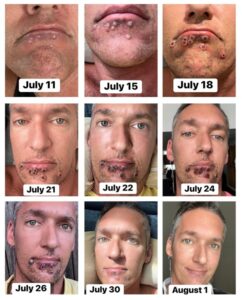
The rash typically will progress through various stages, starting like pimples and progressing to fluid filled blisters that eventually scab over. The lesions are reported to be very painful. The following images were shared publicly from a person with monkeypox to demonstrate progression of the lesions. Not all monkeypox lesions will follow this pattern.
How can monkeypox infection be prevented?
Strategies to reduce the risk of monkeypox infection include:
Avoidance of close contact with anyone suspected to have monkeypox.
Frequent disinfection of common surfaces.
Vaccination of high-risk or recently exposed individuals.
Prompt treatment with antiviral medication for confirmed cases.
Limited vaccines against monkeypox are currently available. JYNNEOS is a vaccine that has been approved for treatment of monkeypox and smallpox. It is available in limited quantities and is allocated by the federal government. Currently local health officials are prioritizing high-risk recipients to try to reduce the outbreak. An overview of the vaccine allocation strategy can be found here: https://www.cdc.gov/poxvirus/monkeypox/interim-considerations/overview.html
Individuals who fit the definition of high-risk should contact their local public health jurisdiction to find out where they can receive vaccine.
ACAM2000 is a vaccine approved for immunization against smallpox. People born before 1972 may have received smallpox vaccination as part of routine childhood vaccinations. Many members of the military may have received smallpox vaccination. Vaccination against monkeypox is not recommended if an individual has received a smallpox vaccine within the previous 3 years.
zithromax
Is there any treatment for monkeypox?
Care for most people is symptomatic with an emphasis on pain control. An antiviral medication, tecovirimat (TPOXX), is available in limited quantities at this time. Its efficacy in treating monkeypox is not yet clear. Those with immune compromise or other health conditions should speak with their doctor about tecovirimat treatment if they suspect monkeypox infection.